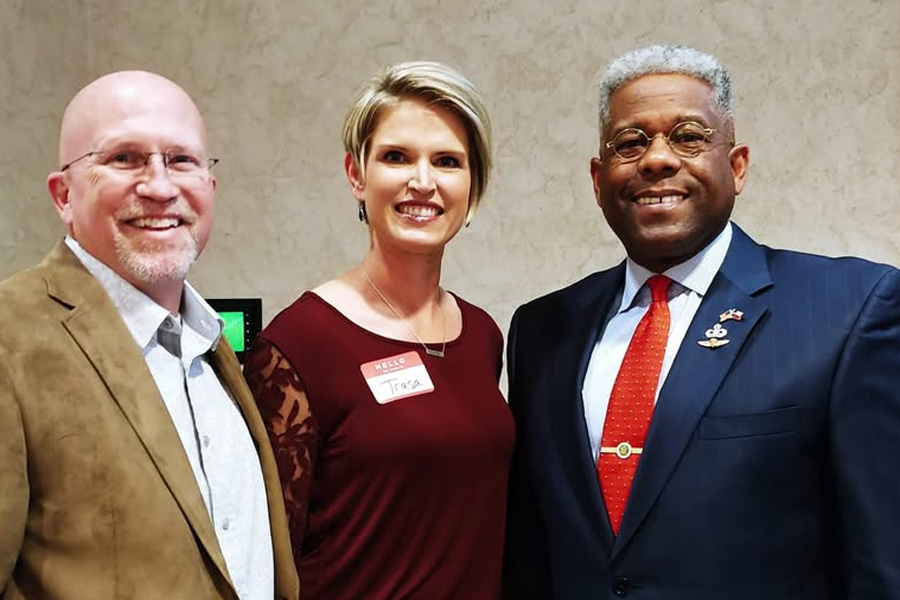
A life shaped by place, duty, and public responsibility
I think the most revealing thing about Trasa Lee Robertson Cobern is not that she comes from a well known family, but that she built a life that could stand on its own feet. Family names can open doors, but they do not write lesson plans, sit through council meetings, or explain local budgets to worried neighbors. Her story has always felt grounded in the ordinary but demanding work of showing up, learning the details, and staying useful. That kind of public life is less like a stage and more like a porch light. It does not dazzle from afar, but it helps people find their way home.
Her path begins with roots that run deep through service, faith, and discipline. Raised in a military family, she learned early that stability is often something you build rather than inherit. Moving from place to place can sharpen the senses. It teaches you to pay attention to people, routines, and community cues. I read her life through that lens. The girl who graduated from a Department of Defense school in Germany did not simply collect credentials. She absorbed a way of living that values adaptability, endurance, and respect for institutions that hold people together.
Education as a foundation, not a finish line
Trasa Lee Robertson Cobern’s academic background matters because it explains more than a résumé line. A degree in political science is not just a credential for someone interested in government. It is a training ground for asking how power works, who benefits from it, and how communities make decisions that feel both fair and practical. Her later graduate work in secondary education and teaching suggests a second lesson, one that often gets overlooked. Teaching is not merely a profession. It is a daily practice in patience, clarity, and moral imagination.
That combination of political thinking and classroom work gives her profile a rare shape. She is not presented as someone who only studied policy from a distance. She lived where policy meets reality. In classrooms, every rule has a consequence. Every budget line becomes a material condition. Every family conversation can reveal where systems help and where they fail. I see that as one of the strongest threads in her public identity. She did not approach civic life as a theory. She approached it as a human problem with real people standing in line.
The classroom also gives her voice a distinct texture. Teachers are trained to translate complexity into language that ordinary people can use. They do not usually have the luxury of jargon. They learn to move from the general to the specific, from the abstract to the practical. That kind of communication matters in local government, where citizens care less about slogans than about roads, taxes, schools, and safety. In that sense, her teaching background feels like a civic instrument, one that turns policy into something neighbors can actually hear.
Family legacy and individual identity
I cannot separate Trasa Lee Robertson Cobern from her family story, but I also do not think her life should be flattened into it. The Robertson name carries cultural recognition, especially through the public visibility of her father, Silas “Si” Robertson, and the broader family associated with Duck Dynasty and Duck Commander. That kind of heritage can be both a spotlight and a shadow. It can make people curious before they know anything else. It can also tempt the outside world to reduce a person to an inherited label.
Her public life resists that reduction. The family connection is real, but it is not the whole script. Her choices point toward a different kind of identity, one built through municipal service, educational work, and civic participation. That matters because many people live in the tension between family expectation and personal direction. Trasa seems to have navigated that tension by refusing to choose between belonging and independence. She holds both. The family story gives her context. Her own work gives her shape.
I also think family, for her, appears less as an accessory and more as a worldview. The repeated emphasis on marriage, children, faith, and responsibility suggests a public philosophy rooted in household life. This is not unusual in conservative civic culture, but what makes it interesting here is the consistency. Family is not presented as a talking point. It is presented as a structure of meaning. That gives her public voice the texture of someone speaking from a lived environment, not from a script. The home becomes a kind of compass.
City government and the discipline of the local
There is something deeply revealing about choosing municipal service. City government is where political language gets tested against reality. It is not glamorous. It is not usually framed by grand speeches. It is the land of zoning, drainage, neighborhood concerns, permits, budgets, and constituents who want a straight answer. That is exactly why it matters. Local government is the place where democracy becomes concrete.
Trasa Lee Robertson Cobern’s service on the Hurst City Council shows a preference for the kind of work that is easy to overlook and hard to do well. People often admire national politics because it looks dramatic, but local leadership is where one learns whether a person can listen, compromise, and remain accountable. It is the civic equivalent of tending a garden. The results are visible only if you keep returning to the soil.
I find that meaningful because local office demands a particular kind of courage. There is no hiding behind broad rhetoric for long. A resident with a drainage problem does not need a lecture. A taxpayer worried about waste does not want abstraction. A school community wants action that feels clear and sensible. In that environment, a leader’s values are not measured by volume but by consistency. Her record suggests a steady commitment to the practical life of a city.
That same practical orientation appears in her county campaign as well. County administration can seem invisible until something goes wrong. Property records, vehicle registration, and tax collection are the mundane gears that keep public systems moving. Few people think about them until they matter. Her willingness to step into that space suggests a willingness to work in the backstage areas of government, where the machinery hums or stalls depending on who is willing to manage it.
The language of stewardship
What stands out to me most in Trasa Lee Robertson Cobern’s public image is the language of stewardship. She seems drawn to the idea that government should be careful, responsive, and grounded in duty. Stewardship is a useful metaphor here. It suggests that resources do not belong to the caretaker, only the responsibility does. A steward preserves what others depend on. That is a quieter form of leadership, but often a more durable one.
This approach also helps explain why her profile resonates with people who prefer substance to spectacle. She appears to move through public life with a teacher’s seriousness and a neighbor’s directness. That blend is powerful. It can make civic work feel less like performance and more like maintenance of shared life. Streets, schools, taxes, and public trust are not abstract concepts. They are the scaffolding of a town. When someone treats them with care, the whole structure feels more livable.
I also see in her story a reminder that public service is not only for those who seek attention. Some people lead by occupying the loudest room. Others lead by returning again and again to the places that need attention. Her work seems closer to the second model. It is the kind of leadership that resembles a well tended bridge. You may not notice it every day, but you rely on it constantly.
Community presence beyond office
A person’s public life does not end at the ballot box, and Trasa Lee Robertson Cobern’s story reflects that. Community work, civic involvement, family engagement, and faith based participation all widen the frame. They show a person who treats public identity as something lived rather than advertised. That matters because communities are stitched together by more than institutions. They are also shaped by habits of presence, by people who attend, encourage, organize, and respond.
I think this is where her biography becomes especially readable. There is no sharp split between career, family, and civic duty. They appear interwoven, like threads in a fabric that gains strength from repetition. A teacher’s calendar, a parent’s responsibilities, a local official’s obligations, and a community advocate’s commitments all overlap. The result is not a perfect life, but a coherent one.
FAQ
Who is Trasa Lee Robertson Cobern?
Trasa Lee Robertson Cobern is a Texas educator, former city council member, and community minded public figure whose life combines teaching, family leadership, and local civic service. She is also known as a member of the Robertson family.
What makes her public story distinct?
Her story stands out because it is rooted in local service rather than celebrity. I see her biography as a blend of classroom experience, municipal responsibility, and family tradition, with an emphasis on practical community work.
How does her background in education shape her public voice?
Teaching tends to favor clarity, patience, and structure, and those qualities seem to echo in her civic style. Her educational background helps explain why she often appears focused on practical concerns, clear communication, and the needs of families.
Why does her family background matter?
Her family background gives her public life context, especially because the Robertson name is widely recognized. At the same time, her own career shows that she has built an identity through service, not just inheritance.
What kind of leadership does she seem to represent?
She seems to represent stewardship based leadership, the kind that values accountability, fiscal care, and attention to daily community needs. It is a quieter model of leadership, but one that often has lasting impact.
Why is local government important in her story?
Local government is where public decisions become visible in daily life. Her work in city leadership reflects a commitment to the nuts and bolts of community life, including the systems that affect residents every day.
How does family appear in her public life?
Family appears as a central organizing principle in her public messaging and personal identity. It shapes how she talks about responsibility, service, and the values that guide her work.
What broader lesson does her story suggest?
Her story suggests that meaningful public service does not need a national spotlight to matter. It can begin in classrooms, continue in council chambers, and remain anchored in the steady work of helping a community function well.
How Massachusetts Drivers Can Stay Ahead Of Vehicle Repossession
Small Gold Holdings With Big Investment Lessons
How Commercial Foundations Keep Buildings Standing Tall
Keeping Household Finances Afloat During Probate
How Smart Water Management Helps Concrete Outlast The Weather