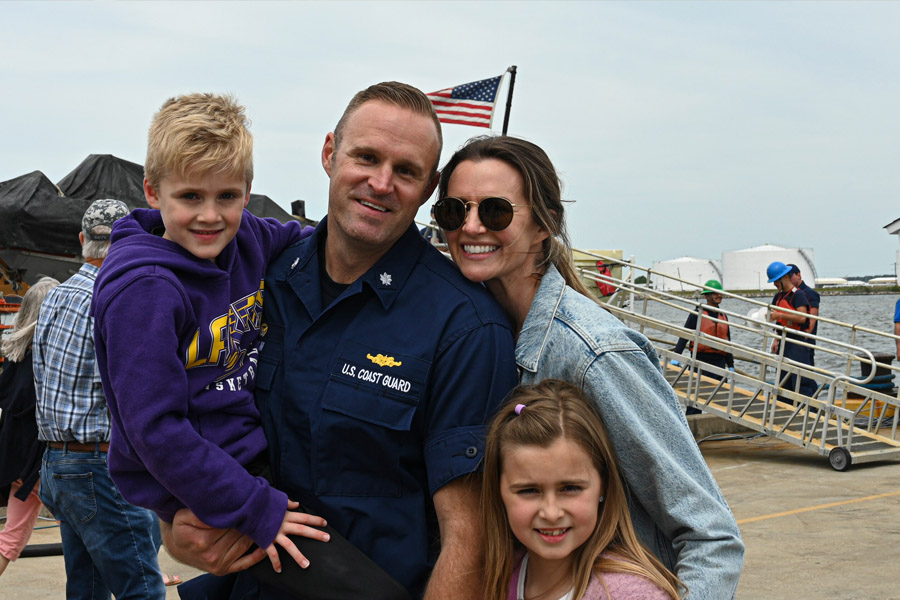
A life shaped by direction, not noise
I keep returning to the same idea when I think about Jeffrey Sky Holm: some lives are built like coastlines. They do not announce themselves with a single dramatic crest. They take shape through pressure, repetition, and weather. His public profile suggests exactly that kind of formation. He stands at a meeting point where service, family memory, and professional discipline all pull in different directions, yet do not break the line.
What interests me most is not just that he served in the Coast Guard, but that his public identity seems to have been formed by a steady relationship with responsibility. That matters because military and maritime service often reveal character in fragments. A rank, a posting, a patrol, a line in a report, a quote in a news piece. Taken alone, each detail is modest. Together, they create a map.
Jeffrey Sky Holm appears to have moved through that map with a kind of deliberate calm. He is not presented as a loud public figure. He is presented as someone who worked inside a system where judgment counts, timing matters, and leadership has to function in bad weather as well as good. That is a very specific kind of life. It is less like a spotlight and more like a beam from a harbor light, narrow but reliable.
Family identity and the weight of a recognizable name
Family can be either a shelter or a shadow. In Jeffrey Sky Holm’s case, it seems to have been both a background presence and a structural force. His name sits inside a family web that includes entertainment, aviation, and a broader lineage of remembered relatives. That kind of inheritance can be complicated. It can create expectation without instruction. It can place a person in the public imagination before the person has even finished building his own path.
What stands out to me is that Jeffrey does not appear to have borrowed a life from that family history. He seems to have made a different kind of legitimacy, one earned through service. If family fame is a bright glass window, a career in the Coast Guard is a steel frame. The two do not cancel each other out. They simply reflect different kinds of strength.
This is where the story becomes more interesting than a simple list of relationships. A public identity built from family recognition alone can feel inherited in the passive sense. But a public identity built from service can become active, tested daily. It is the difference between being known and being relied on. Jeffrey Sky Holm seems to live closer to the second category.
The family story also gives his biography a deeper texture. It suggests a household where motion, performance, and precision were already part of the air. An actor’s world, a pilot’s world, and a military world all ask for discipline in different forms. One works with script, one with engines and risk, one with chain of command and mission. That combination makes his path feel less accidental and more like one branch of a larger tree leaning toward competence.
What command at sea really means
A commanding officer is often described in formal language, but the reality is rougher, sharper, and more human. Command at sea is not simply a title. It is a daily negotiation with uncertainty. The ship moves. The crew adapts. The mission changes. The ocean never agrees to be background scenery. It is an active participant.
That is why Jeffrey Sky Holm’s Coast Guard career feels especially revealing. His public record places him in the role of officer, graduate student, writer, and eventually commanding officer. Those steps suggest more than upward mobility. They suggest widening responsibility. A young officer is tested by training and assignment. A senior officer is tested by judgment, tone, and the ability to carry an entire crew’s confidence without making the work look theatrical.
I find that kind of leadership quietly impressive. It does not depend on charisma alone. It depends on structure, consistency, and the ability to keep moving when the weather turns. At sea, there is no pretending. Either the systems work or they do not. Either the crew trusts the captain or it does not. That is why command becomes a kind of moral weather vane. It points toward what a person values when nobody is clapping.
In Jeffrey’s case, that seems to include readiness, mission focus, and a practical concern for the people under his command. The public mentions tied to his service point to interdictions, patrols, and repatriation work, but the deeper theme is coordination. Service of that kind is a machine made of people, and command is the art of keeping the parts aligned.
The value of a public voice that is still measured
One detail that deepens Jeffrey Sky Holm’s profile is that he is not only a practitioner of service but also a writer within that world. That matters because writing forces clarity. It turns instinct into language. It gives shape to experience before memory blurs it. When an officer writes about mission and preparation, I read that as evidence of reflection, not just performance.
I like that combination. It suggests someone who understands that leadership is not just what happens on deck or in the operations room. It is also the story a crew tells itself about why the mission matters. Words can steady a team the way a handrail steadies a stairway in rough water. They do not replace action, but they help action hold together.
There is also something notable about his relative privacy. Many public figures flood the field with detail. Their lives feel overexposed, like a photograph left too long in the sun. Jeffrey’s public trace feels different. It is visible, but not overstated. There is enough to recognize the shape of the man, but not so much that the shape collapses into spectacle.
That restraint is part of the story. In an age that rewards constant display, a measured profile can feel almost rebellious. It suggests that the work matters more than the performance of the work. For someone in the Coast Guard, that feels especially appropriate. The mission is often important precisely because it is not glamorous.
Why his story keeps pulling attention
I think Jeffrey Sky Holm draws attention for a simple reason: his life sits at the intersection of public inheritance and earned authority. That is a compelling place to stand. On one side is family recognition, the kind that arrives before a person speaks. On the other side is the authority that comes only after years of doing the job, making the calls, and carrying the consequences.
That intersection creates a story with two clocks. One measures lineage. The other measures service. They do not tick at the same pace, but they do shape the same person. His biography feels like a bridge between those clocks. The result is a profile that can be read as personal, professional, and generational all at once.
I also think the ongoing public mention of his name matters because it shows continuity. Some careers flare and vanish. Others leave a steady echo. Jeffrey’s name appears in contexts that suggest memory rather than trend. That kind of staying power is often the mark of work that mattered to real people in real conditions.
The broader lesson here is not simply about one officer. It is about how a life can remain legible without becoming overexposed. Jeffrey Sky Holm seems to represent a kind of modern dignity that is easy to miss if one only looks for celebrity. His story is quieter than celebrity, but more durable.
FAQ
Who is Jeffrey Sky Holm?
Jeffrey Sky Holm is a U.S. Coast Guard officer whose public identity is shaped by service, leadership, and a family background that is already recognizable in other public circles.
What makes Jeffrey Sky Holm’s career notable?
His career is notable because it shows a progression from commissioning and graduate study to command responsibility at sea. That path suggests sustained discipline rather than a single standout moment.
Why does his family background matter?
His family background matters because it connects him to entertainment and aviation, which gives his public profile a layered quality. It also helps explain why people notice his name beyond his military service.
Is Jeffrey Sky Holm known only for his Coast Guard work?
No. He is also connected to family visibility and has appeared in contexts that suggest a reflective, written dimension to his professional life. That gives his profile more depth than a simple service record.
What does his story suggest about leadership?
It suggests that leadership can be quiet, practical, and steady. His public image points to competence under pressure, which is often the real test of command.
Why does his public presence feel unusual?
It feels unusual because it combines public family recognition with a service career that is disciplined and relatively restrained. That mix creates a profile that is visible without being overexposed.
What is the main theme of Jeffrey Sky Holm’s public life?
The main theme is responsibility carried across generations and institutions. Family history gives the frame, while Coast Guard service gives the structure inside it.
Making Room For Real Life With An Essex Home Extension
Building A Backlink Reputation That Search Engines Trust
When Your Air Conditioner Starts Acting Like A Drama Queen
Making Container Moves Behave Like A Well Rehearsed Parade
Park City Comes Alive Through Art Music And Mountain Culture